


When rain starts falling more often, so do the little everyday changes: damp corners stay wet longer, puddles linger near play areas, and water collects in spots you’d normally walk right past.
As a mom, you’re always in protect mode. But these small signals are your reminder: it’s time to step up your family’s outdoor protection, starting with what goes on their skin.
Skip the Risk: What to Watch Out for in Outdoor Protection
Not all outdoor lotions and sprays are created with long-term care in mind. While some may promise strong protection, a closer look at the label can reveal ingredients you’d rather keep off your family’s skin especially when used daily.
- DEET, for instance, is widely used for its effectiveness, but excessive use or not following instructions exactly can lead to skin irritation and raise safety concerns. 1
- Parabens are classified in the group of endocrine-disrupting chemicals (EDCs), raising concerns about their long-term effects on hormone balance.2
- Phthalates, some of which are also suspected EDCs3, have been linked to increased risk of allergic diseases such as asthma and eczema in children. Prenatal exposure, in particular, has been associated with developmental concerns—including potential effects on learning, attention, and behavior later in childhood.4
If you already check food and skincare labels, it makes sense to do the same for outdoor protection especially when it’s something your kids wear on their skin.
Citronella-Powered Protection, Safe for the Whole Family
You shouldn’t have to choose between strong and safe. A well-made, gentle formula can deliver both.
Human Nature’s Skin Shield Oil and Skin Shield Lotion are natural, DEET-free outdoor protection options thoughtfully made for families who care about what goes on their skin. Both are safe for kids, as well as pregnant and breastfeeding women, and combine the protective power of citronella with a blend of eucalyptus, orange, and soybean oils—ingredients that help mask your skin’s natural scent, which mosquitoes are drawn to. Coconut oil adds moisture, so skin stays nourished too.


No sting. No sticky feel. No risks! Just everyday protection you can feel good about—whether the kids are off to school, you’re running errands, camping for the weekend, or heading out for a park playdate.
Because when it comes to your family, safety should never come with side effects.
What Makes Citronella Oil Effective?
More people are turning to plant-based options for outdoor protection, in part because research suggests they may have fewer adverse effects on humans than synthetic alternatives like DEET (N,N-diethyl-3-methylbenzamide)5.
One plant-based ingredient that has long been used for outdoor protection is citronella oil. You probably know it for its fresh, citrusy scent but there’s more to this familiar oil than meets the nose.
How Does Citronella Oil Work for Outdoor Protection?
Citronella can make it tougher for mosquitoes to detect us, thanks to three of its main compounds—citronellal, citronellol, and geraniol.
A 2026 study found that citronella oil made it harder for Aedes aegypti mosquitoes to find, land on, and feed from a host. It also affected how they responded to carbon dioxide (CO₂), one of the cues mosquitoes use to zero in on us.6
So while we know (and love!) citronella for its fresh, citrusy scent, its natural compounds are doing more than simply smelling good. They make citronella such an effective ingredient for outdoor protection!
The Difference Between DEET and Citronella: A Styrofoam Showdown
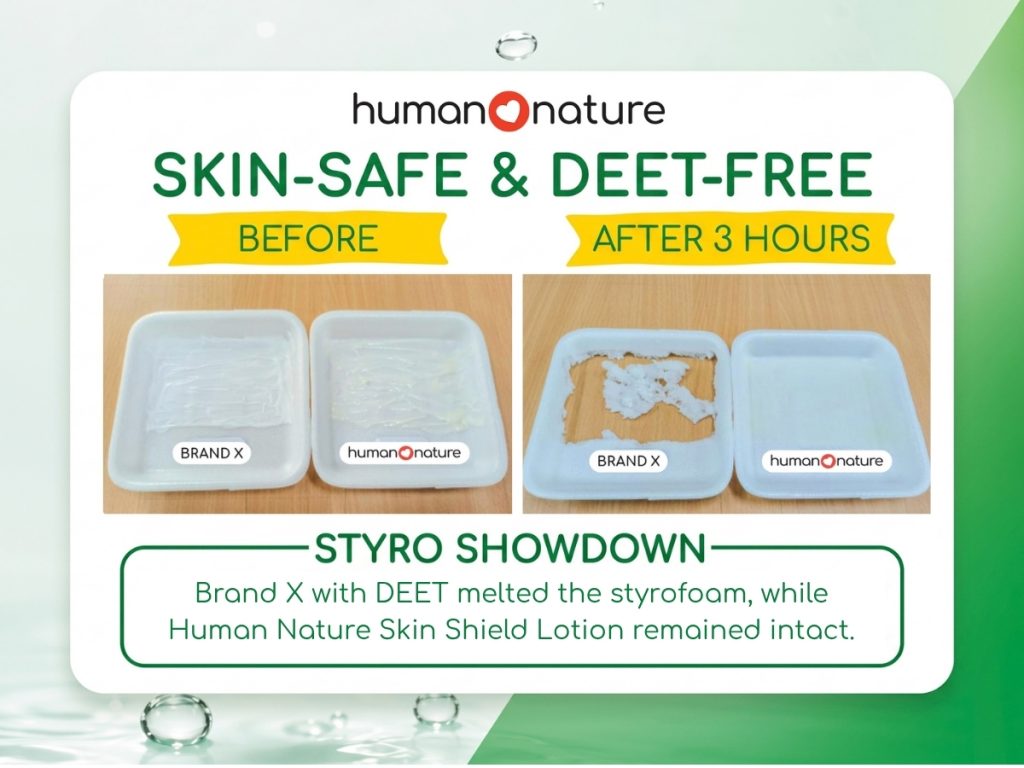
DEET is widely used for outdoor protection, but it isn’t without concerns. Overuse or improper use can cause skin irritation, while rare cases of more serious reactions have also been reported, including seizures, low blood pressure, agitation, and other neurological effects.¹
At the same time, it’s worth looking at the full picture. Some sources consider DEET generally safe when used exactly as directed, though it is not recommended for infants under 6 months.7
But would you really want to take the risk with your kids?
In this simple styrofoam test, the difference is hard to miss. After three hours, the piece exposed to the DEET-containing product showed visible breakdown, while the piece exposed to Skin Shield remained intact.
And when it comes to what goes on our kids’ skin? We don’t know about you, but that’s a difference we’d rather not risk.
See how other parents are putting Skin Shield to the test and feeling good about what they’re choosing for their families.
Frequently Asked Questions
How does citronella oil help deter mosquitoes?
Citronella oil can make it harder for mosquitoes to find and approach us. Its natural compounds, including citronellal, citronellol, and geraniol, can interfere with some of the signals mosquitoes use to zero in on people. This helps explain why citronella has long been used in outdoor protection.
Is citronella oil a plant-based alternative to DEET?
Yes. Citronella oil is a plant-based ingredient used in outdoor protection as an alternative to synthetic ingredients like DEET. Research has found that citronella and its natural compounds can help deter mosquitoes, making it a popular choice for those looking for plant-based outdoor protection.
Is DEET safe for children?
DEET has been linked to side effects including skin irritation, rashes, headaches, nausea, dizziness, and, in rare cases, more serious reactions such as seizures and low blood pressure, particularly with excessive use.
That said, some sources consider DEET generally safe for children when used exactly as directed. Precautions still apply, including avoiding over-application, keeping it away from the eyes and mouth, and not letting young children apply it themselves.
What is a good citronella oil option for kids?
Human Nature Skin Shield Oil is a family-friendly, DEET-free outdoor protection oil made with citronella, eucalyptus, orange, soybean, and coconut oils. Human Nature states that it is safe for kids, as well as pregnant and breastfeeding women, and made with 100% natural ingredients.
What are plant-based, DEET-free options for outdoor protection?
For families looking for plant-based, DEET-free options, citronella-based formulas are one choice. Human Nature Skin Shield Oil and Skin Shield Lotion use citronella alongside eucalyptus, orange, and soybean oils, and are formulated without DEET. Both are made for everyday outdoor activities and are stated to be safe for kids.
Sources:
- Agency for Toxic Substances and Disease Registry. (2017). DEET (N,N-diethyl-meta-toluamide). ATSDR DEET. ↩︎
- Nowak, K., Ratajczak-Wrona, W., Górska, M., & Jabłońska, E. (2018). Parabens and their effects on the endocrine system. Molecular and Cellular Endocrinology, 474, 238–251. ↩︎
- Braun, J. M., Sathyanarayana, S., & Hauser, R. (2013). Phthalate exposure and children’s health. Current Opinion in Pediatrics, 25(2), 247–254. ↩︎
- Environmental Working Group. (2024, September 24). What are phthalates?. ↩︎
- Eden, W. T., Alighiri, D., Supardi, K. I., & Cahyono, E. (2020). The mosquito repellent activity of the active component of air freshener gel from Java citronella oil. Journal of Parasitology Research, 2020, Article 9053741. ↩︎
- Drahun, I., Sparrow, J. M., Koloski, C. W., & Cassone, B. J. (2026). Transcriptional responses of Aedes aegypti chemosensory tissues in response to volatile DEET and citronella oil. Insect Molecular Biology, 35(5), 526–540. ↩︎
- Environmental Working Group. (2023, August 14). EWG’s guide to bug repellents. ↩︎
